
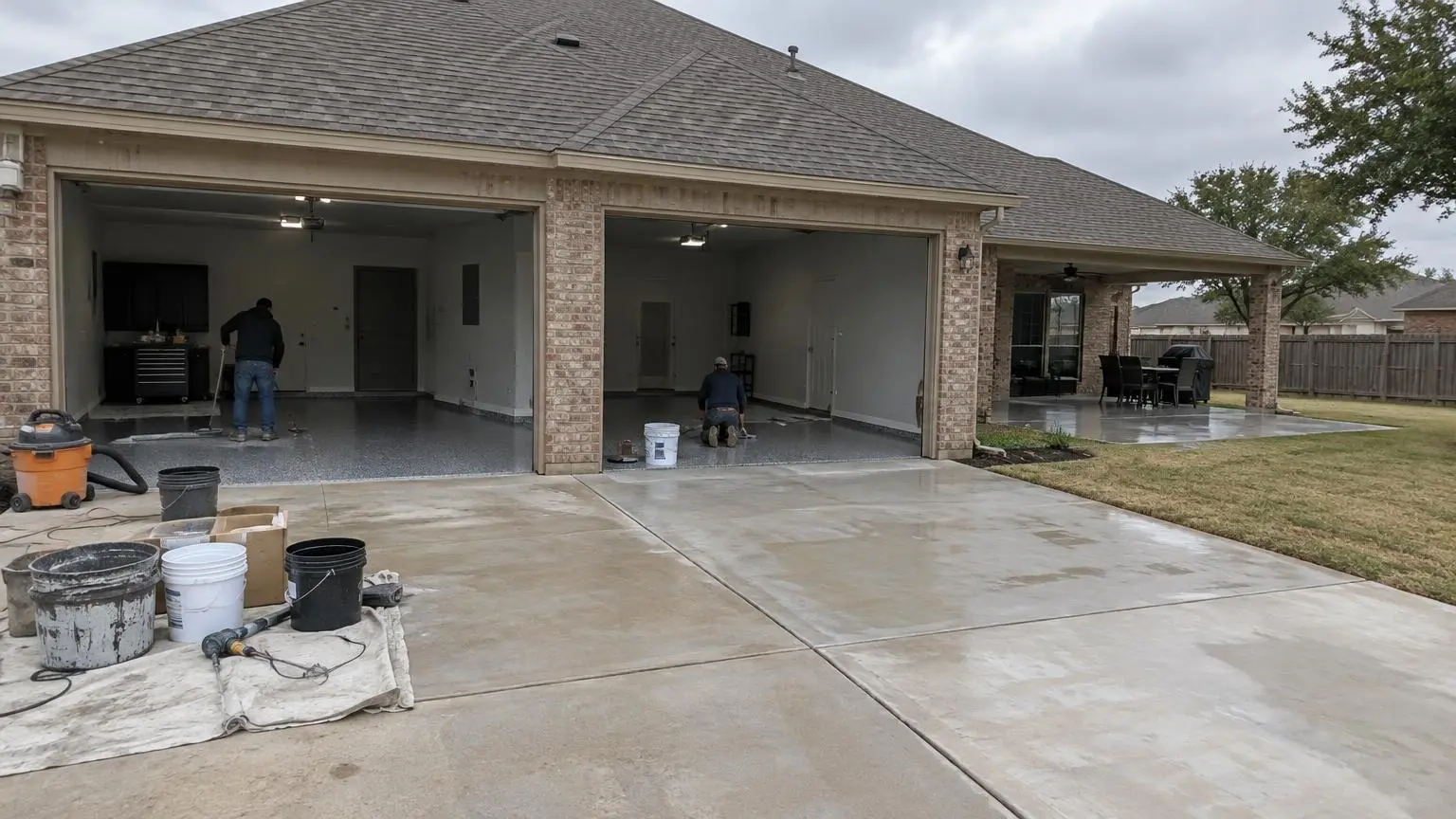
Garage floor coatings for Arlington & DFW
Epoxy Flooring in Arlington, TX
Diamond-ground prep, cracks repaired first, and a coating chosen for North Texas heat, so your garage floor stays bonded and easy to clean.
- Free on-site estimates
- Written, itemized quote before work starts
- Diamond-ground prep and a slab moisture check before coating
Garage Floors Built for North Texas Summers
Epoxy flooring in Arlington is mostly about garages. Many of the homes here sit on concrete slabs with attached garages, and bare gray concrete stains, dusts and pits over time. A coated floor seals the slab, wipes clean, and turns the garage into usable space for a workshop, gym or storage. The catch is that a coating is only as good as the prep under it and the system on top of it, and Arlington's heat and clay soil are hard on both. Our job is to pick a system that holds up here, not just one that looks good on day one.
What makes Arlington garages different
Arlington sits in Tarrant County, about 12 miles east of downtown Fort Worth and 20 miles west of downtown Dallas. Its July average high is about 94°F, and the National Weather Service puts the average first 100-degree day at DFW on July 1 and the last on August 27. In 2011 DFW logged 71 days at 100°F or more. A closed garage gets hotter than the air outside, and a car driven on hot pavement brings that heat into the garage in its tires. That is the setting for hot tire pickup, where a soft or poorly bonded coating lifts off the slab under parked tires. Heat also shortens the working time of epoxy, so mixing and spreading have to be planned for it.
Hot tire pickup and how to avoid it
Hot tire pickup is the most common complaint about garage floor coatings, and it is mostly a prep and product problem. Heat and chemicals from tires soften a weak coating and pull it off concrete that was never properly profiled. Coating makers point to the same causes: concrete that was only cleaned or acid-etched instead of ground, moisture coming up through the slab, and thin, low-solids coatings without a tough topcoat. That is why we diamond grind every floor, check for moisture, and build the coating to a real thickness with a wear-resistant topcoat. Thin one-day DIY kits from the home center are where most peeling floors come from.
Clay soil and slab cracks
Much of North Texas sits on expansive black clay that swells when it is wet and shrinks when it dries; in summer and drought you can see the cracks open in the ground. Slabs on that soil move, and many Arlington garages have at least a few cracks, often running from the corners of the door or along control joints. A coating will not stop a slab from moving. What we can do is clean out and fill cracks with a repair material made for concrete, grind it flush, and tell you honestly which cracks are cosmetic and which are moving enough that a hairline may show through again. If we see signs of a foundation problem, we say so before quoting a coating.
Epoxy, flake, polyaspartic or metallic?
For most garages we recommend a flake system: a base coat, a full broadcast of colored vinyl flakes, and a clear topcoat. The flakes hide dust and small flaws and add texture so the floor is less slippery when wet. Epoxy makes a strong, thick base coat, but it can yellow in sunlight. Polyaspartic topcoats resist UV and cure fast, which matters for garages that sit open to afternoon sun and for patios. Metallic epoxy gives a poured, marbled look and suits interior rooms more than working garages. We explain which mix fits your space and budget at the estimate.
What a typical garage floor job includes
- Moving out or working around stored items, as agreed in the quote
- Diamond grinding the whole floor to open the concrete surface
- Filling cracks, pits and spalled spots and grinding repairs flush
- A moisture check and the right primer or base coat for the slab
- Base coat, flake broadcast if chosen, and a clear wear-resistant topcoat
- Cove or edge detail at the walls and a clean transition at the garage door
- Written cure times for walking on the floor and parking on it
What it costs
HomeGuide's garage floor coating guide (its Arlington page uses general, not local, figures) puts epoxy at about $4 to $10 per square foot for materials and professional labor, polyaspartic at about $5 to $12, and polyurea at about $5 to $10. HomeGuide's national guide lists a typical two-car garage (400 to 576 square feet) at $1,600 to $5,800 for epoxy. Crack repair, old coating removal and decorative upgrades move the number. We give you a written price after measuring the floor.
Where We Work
Arlington is home base: a Tarrant County city of 394,266 people at the 2020 census, in the Mid-Cities between Dallas and Fort Worth. From Arlington we work across the Dallas–Fort Worth area, including Grand Prairie, Mansfield and Kennedale to the east and south, Fort Worth to the west, and the Mid-Cities to the north. The same clay soil and summer heat run across the whole area, but homes differ from city to city: older neighborhoods often have slabs with decades of oil stains, old paint and settled cracks, while newer subdivisions have cleaner, harder slabs that still need grinding before anything will bond. Each area page covers what we see there.
- Epoxy Flooring in Arlington, TX
- Epoxy Flooring in Pantego, TX
- Epoxy Flooring in Dalworthington Gardens, TX
- Epoxy Flooring in Grand Prairie, TX
- Epoxy Flooring in Mansfield, TX
- Epoxy Flooring in Kennedale, TX
- Epoxy Flooring in Fort Worth, TX
- Epoxy Flooring in Forest Hill, TX
- Epoxy Flooring in Everman, TX
- Epoxy Flooring in Crowley, TX
- Epoxy Flooring in Burleson, TX
- Epoxy Flooring in Rendon, TX
- Epoxy Flooring in Euless, TX
- Epoxy Flooring in Bedford, TX
- Epoxy Flooring in Hurst, TX
- Epoxy Flooring in Colleyville, TX
- Epoxy Flooring in Grapevine, TX
- Epoxy Flooring in Southlake, TX
- Epoxy Flooring in Keller, TX
- Epoxy Flooring in North Richland Hills, TX
- Epoxy Flooring in Haltom City, TX
- Epoxy Flooring in Watauga, TX
- Epoxy Flooring in Irving, TX
- Epoxy Flooring in Coppell, TX
- Epoxy Flooring in Dallas, TX
- Epoxy Flooring in Cedar Hill, TX
- Epoxy Flooring in Duncanville, TX
- Epoxy Flooring in DeSoto, TX
- Epoxy Flooring in Lancaster, TX
- Epoxy Flooring in Midlothian, TX
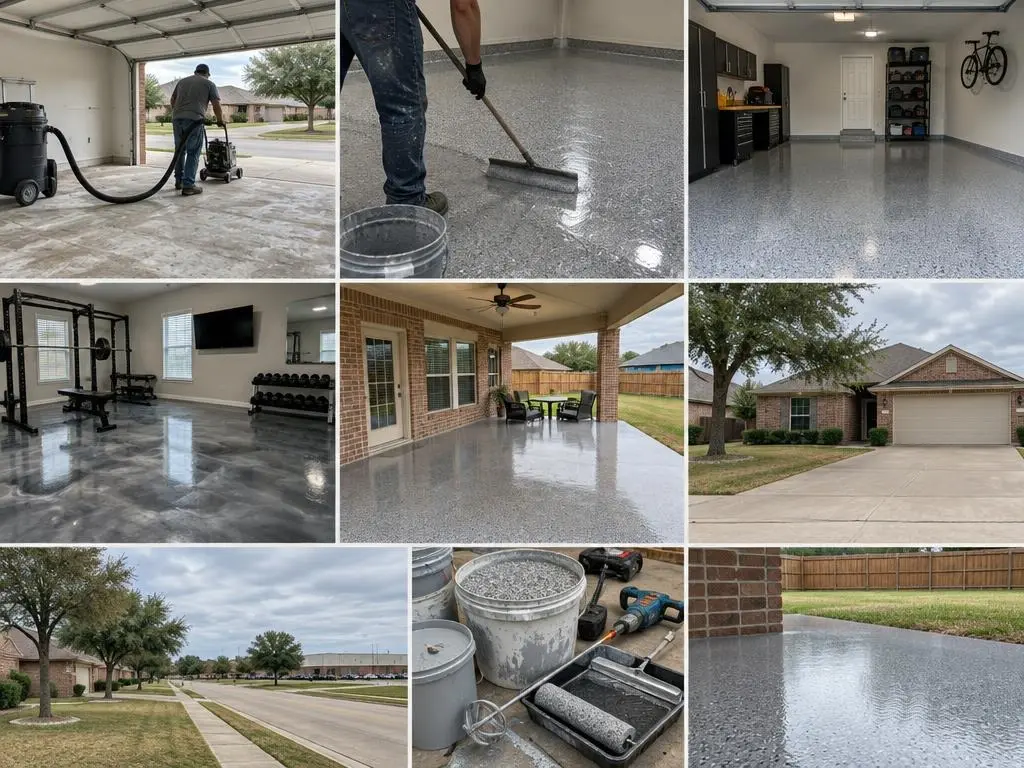
Common Questions
How much does epoxy flooring cost in Arlington, TX?
HomeGuide's published figures put garage floor epoxy at about $4 to $10 per square foot installed and polyaspartic at about $5 to $12. A two-car garage commonly lands somewhere between $1,600 and $5,800 for epoxy, depending on size, prep and repairs. We give you a written price after measuring and inspecting the floor.
What is epoxy garage floor coating?
It is a two-part resin that is mixed on site and applied to prepared concrete, where it hardens into a thick, bonded layer. In a garage it seals the slab against oil and stains, stops concrete dust, and is easy to clean. Most residential systems add colored flakes and a clear topcoat for texture and wear resistance.
What are the disadvantages of epoxy flooring?
Epoxy can yellow in direct sunlight, it can be slippery when wet without flakes or an anti-slip additive, and it fails if the concrete is not properly prepared. It also takes longer to cure than polyaspartic. Cracks in the slab can eventually telegraph through if the slab keeps moving. We use flakes, UV-stable topcoats and diamond-ground prep to deal with most of these.
How much epoxy do I need for 1,000 square feet?
It depends on the product and the thickness. HomeGuide notes coverage of roughly 80 to 200 square feet per gallon, so 1,000 square feet can take anywhere from about 5 to more than 12 gallons per coat, and most systems have two or three coats. For a professional install, we figure material for each coat from your exact measurements.
Will an epoxy garage floor peel from hot tires in Texas?
A properly installed system should not. Hot tire pickup usually traces back to concrete that was not ground, moisture coming through the slab, or a thin, low-solids coating. We diamond grind, check for moisture, and use a thick base with a wear-resistant topcoat to avoid it.
How long before I can park on a new garage floor?
It depends on the system and the temperature. Polyaspartic topcoats cure much faster than epoxy, so a polyaspartic system usually returns the garage to use sooner, while an all-epoxy system needs more days before cars. The manufacturer's cure times for your system, adjusted for the weather, are written into your quote.
Can you coat a garage floor with cracks?
Yes, in most cases. We clean out and fill cracks, pits and spalls and grind the repairs flush before coating. On North Texas clay soil, slabs that are still moving can show a hairline through the coating later, and we point those out at the estimate.
Our Epoxy Flooring Services
Six coating systems cover garages, patios, interior rooms and commercial floors, each matched to how the floor is used and how much sun and heat it sees.
Garage Floor Epoxy
A ground, repaired and fully coated garage floor that resists oil, hot tires and Texas heat.
Learn more →Epoxy Flake Floors
Colored vinyl flakes broadcast into the base coat for texture, grip and a floor that hides dust.
Learn more →Polyaspartic Floor Coating
A fast-curing, UV-stable coating for sunny garages and anyone who needs the floor back quickly.
Learn more →Metallic Epoxy Floors
Poured metallic epoxy with a marbled, three-dimensional look for game rooms, gyms and showpiece garages.
Learn more →Patio & Outdoor Concrete Coatings
UV-stable coatings and sealers for patios, porches and pool-adjacent slabs that bake in Texas sun.
Learn more →Commercial & Warehouse Floor Epoxy
Heavy-duty epoxy systems for shops, warehouses, retail spaces and service bays, scheduled around your hours.
Learn more →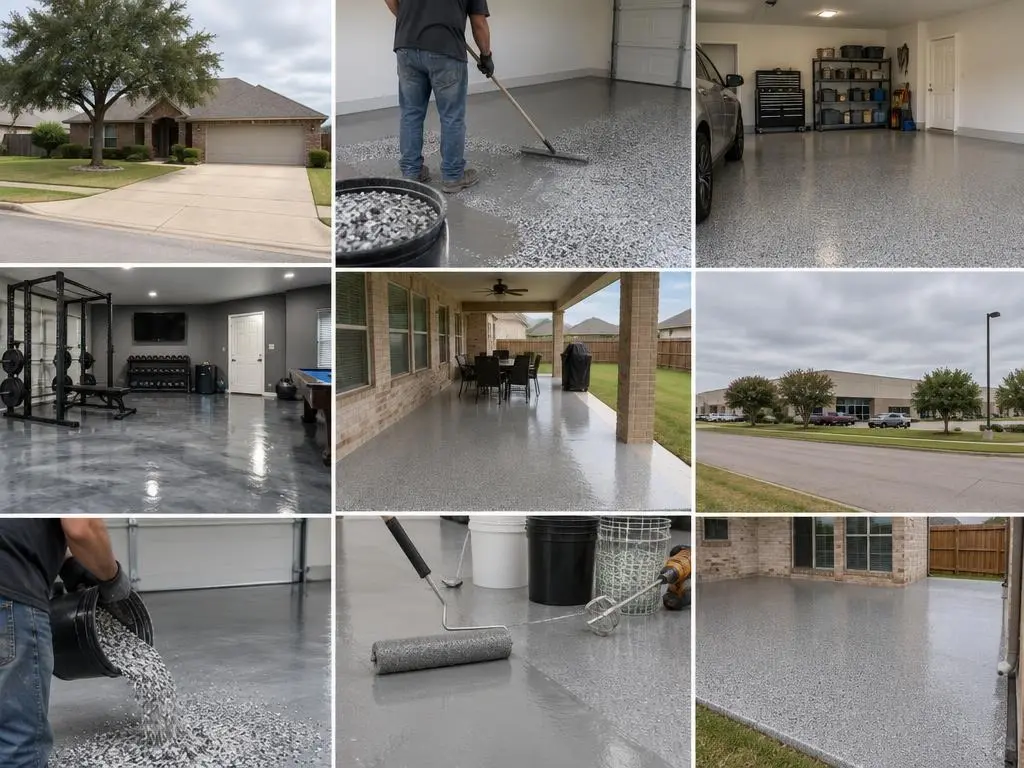
Why Homeowners Call Arlington Epoxy Flooring Pros
Ground, not just washed
Every floor is diamond ground so the coating bonds to open concrete, which is the main defense against peeling and hot tire pickup.
Cracks handled first
Cracks, pits and spalls are filled and ground flush, and we tell you which cracks may show through again on moving clay-soil slabs.
Coatings chosen for heat and sun
UV-stable polyaspartic topcoats where sun hits the floor, and work timed around North Texas heat.
One written price
Your quote lists square footage, prep, repairs, the coating system and cure times. Nothing is added without your written approval.
Get an Epoxy Flooring Estimate
Free on-site estimates in Arlington and across the Dallas–Fort Worth area.